
Onimusha is a brilliant action game with some of the best pacing and animation ever released



Pros
- Great combat, with countless mechanics and nuances to learn
- Impressive boss fights and spectacle
- Industry-leading pacing and progression
- Truly stunning combat and facial animations
Cons
- Still unsure about the inclusion of Toshiro Mifune
The term “generational run” gets thrown around about Capcom a lot these days, and to some extent it’s not hard to understand why. The company spent most of the Xbox 360/PS3 generation struggling to get up to speed with the higher demands of creating an HD production pipeline, paired with something of a culture of trend-chasing that continued into the early years of the PS4 and Xbox One. This resulted in everything from underwhelming new series like Dark Void and Remember Me to disastrous launches like Street Fighter 5, and well-established franchises like Resident Evil feeling lost in the forest thanks to the high-profile messes like Resident Evil 6, Operation Raccoon City, and Umbrella Corps.
Sometimes it does seem like near-endless praise for Capcom’s line-up post-Resident Evil 7 has become a self-fulfilling hyperbolic ritual, fueled simply by the studio being one of the few modern-day triple-A publishers releasing a large number of games every year without constantly getting drawn into needless controversy or self-imploding thanks to countless high-level directional pivots. Despite early acclaim, games like Monster Hunter Wilds and Resident Evil Village have had rather swift and harsh reevaluations post-release; however, it is games like Onimusha: Way of the Sword that really prove that no one is doing it like Capcom right now.

Capcom’s post-Resi 7 hot streak continues with Onimusha: Way of the Sword.
Style and substance
In a year when Capcom already oversaw the release of a great game in a long-running series through Resident Evil Requiem and a delightfully innovative new IP in Pragmata, Onimusha feels like it completes the trifecta. Way of the Sword rejuvenates the long-dormant franchise with such verve and excitement that it’s as if the series is breaking out of the depths of Hell, like the Genma in the game itself, to remind us of the presence it can have.
While the most instantly noticeable thing about Onimusha is how good it looks and runs, there is so much more to the game than just its presentation. Much like Pragmata a few months ago, Onimusha’s greatest strength isn’t just that its mechanics are satisfying and unique — it’s that Capcom seems to have honed the art of pacing and how to dole out these new ideas so effectively that, basically, no other games feel this good to breeze through on a first playthrough.
Despite the sometimes-frenetic speed, everything that happens is down to you, as a player, making a choice, directing the combat, and managing combatants.
Onimusha is yet another in a long line of Simon Says games. The game says “parry”, you parry. The game says “dodge”, you dodge. However, to leave it there would be reductive. From pretty much the opening encounter, the game ever so slowly folds in new wrinkles to combat. Yes, you can parry and dodge, but there are also Issen attacks. These are even more precise than a parry — essentially, if you can hit a frame-or-two-wide window and attack right as an enemy tries to strike you, you can slash straight through their blow, dealing massive damage.
New combat systems like this are layered on to the game’s foundation, what feels like every thirty minutes. Just as you learn to master one move, shield breaks are brought in, and once you have got the hang of that, you can unlock counters on consecutive perfect dodges. All these powers — be they gained through upgrading gear and skill trees, learning new techniques, or simply developing muscle memory — are continuously engaged with by the game. The result is a combat system overflowing with depth that allows you to go incredibly deep as you become more literal in the game’s language.

Yes, this is a parrying game. But there’s a lot more to it.

Combat is technical, deep, and rewarding.
But the style, though…
However, while the combat really should be highlighted, it is near endlessly elevated by production values that are not only worthy of such a system, but make it better. The big thing here is that animations being so detailed is a vital part of gameplay; being able to tell what kind of attack an enemy is winding up is vital to survival. You’re then rewarded with truly badass-looking deflects, parries, clashes, and finishers when you engage with those systems fully.
Calling action “cinematic” is rather rote at this point, because it usually just means “flashy” with little control for a player. However, Onimusha isn’t cinematic in that way; it’s cinematic in that it feels deliberate. Despite the sometimes-frenetic speed, everything that happens is down to you, as a player, making a choice, directing the combat, and managing combatants. It is very defensive in places, as you wear down enemies’ stagger bars, but the result is that when you get into a flow, you are essentially acting as a puppet master, toying with enemies as you brush off their attempted assaults and push forward with your own.
While managing the game’s myriad weaker enemies is fun for a time, the real reward comes from dealing with the challenges that punctuate each story beat. Onimusha’s bosses might not be as plentiful as those in a FromSoftware game; however, they more than make up for it with their presence. Be it recurring characters’ stories being told through the progression of their movesets and character designs, or grand encounters topped off with killer cutscenes, these setpieces give life to both the story of Onimusha while also tying together the game’s mechanics in packages that are rewarding to learn in their own right.
Memorable Miyamoto Musashi
The Onimusha games have always been rather narrative-heavy, but the success of those stories and how memorable they are beyond the occasional celebrity cameo has always been up for debate. In some ways, that is where old habits die hard with Way of the Sword; while Jean Reno and Takeshi Kaneshiro are not present, the likeness of legendary Japanese actor Toshiro Mifune is used for the protagonist, a fictionalized version of the real-life swordsman, artist, and tactician Miyamoto Musashi.
This kind of digital resurrection is something that generally does not sit well with me. I have been rather vocally against the inclusion of the likenesses of deceased celebrities in games, like Tupac in the upcoming Stranger Than Heaven, and I sat on the fence upon hearing about Mifune’s inclusion in this game, too. This kind of move isn’t new to the series. Onimusha 2: Samurai’s Destiny featured the likeness of Japanese actor Yûsaku Matsuda, who died in 1989 at the age of 40.
Onimusha: Way of the Sword might have the most expressive facial animation of any game ever released. The way the faces contort with exasperation and stretch with stress is truly something to behold.
In the case of Matsuda, his likeness had been the unofficial inspiration for characters like Spike Spiegel in Cowboy Bebop and Kenshiro in Fist of the North Star for years, so at least officially licensing his likeness back in 2002 would have resulted in compensation for his surviving family. In Way of the Sword, both Shirô and Akemi Mifune (Toshiro’s son and daughter-in-law) are credited in the game under “Mifune Productions Co., Ltd.”, which is somewhat reassuring. What is much more reassuring is that Way of the Sword goes above and beyond to capture the expressiveness and mannerisms of the much-celebrated screen presence.
Despite this, I still feel somewhat hesitant to say I am a fan of this stunt casting. Ultimately, this work could have gone to a living motion capture artist – there almost assuredly was a motion capture performer used on set, but having watched the whole credits, I couldn’t tell you who they were. Moreover, just because an actor’s estate signed off on the use of a deceased relative’s likeness doesn’t make it automatically right; it just means that they are ok with it. The thing that does soften my view of Mifune’s casting here compared to, say, Volkswagen resurrecting Gene Kelly for a Golf GTI advert in 2005, is the care Capcom has put into capturing the details of Mifune when depicting Musashi.

Protagonist, Miyamoto Musashi, is wonderfully expressive, but using the likeness of the late, legendary Japanese actor Toshirō Mifune can feel uncomfortable.
The many faces of an actor
Onimusha: Way of the Sword might have the most expressive facial animation of any game ever released. The way the faces contort with exasperation and stretch with stress is truly something to behold. The bubbly young Okuni is a great example, with her naivety and joy for life etched into her every reaction. However, Miyamoto is the real star.
Never before have I seen a video game capture the feeling of “I am so done with this shit” as Miyamoto’s face when he realizes he is going to have to draw his sword to deal with yet more petulant fools. Nor have I seen looks so quizzical or bemused as he is bombarded with new information. This, paired with the game’s excellent animation for movement and combat, grounds both cutscenes and gameplay in Way of the Sword in reality, no matter how fantastical the action may get.
These kinds of expressions littered Mifune’s career to the point that grimaces of deep focus and scowls of confusion that are all over Onimusha are near synonymous with his work with Akira Kurosawa. I am not sure if all this has convinced me that including Mifune is something I am at all comfortable with, let alone a net positive for the experience. However — while I probably would have been just as happy to have Miyamoto’s face be based on no one — it is not distracting in the moment, at least not in a negative way, and it is never in bad taste.
Moreover, Musashi is deeply likeable himself. He manages to combine a constant reluctance and nonchalance with a genuine steely determination that makes his arc not just believable, but mirror the player’s investment and growing skill.
Stories of legend
The larger story beats of Way of the Sword are far from complicated. Most of the powers, actions, or motivations of the Genma and Oni are either not elaborated on or simply exist to push the action forward. However, where the game excels is in the characterizations of its cast. From slimy and duplicitous villains like Ganryuu, to your small group of allies in Shizuka, Takamura, and the aforementioned Okuni, the way these characters interact with Musashi is always a joy to watch unfold.
Moreover, Musashi is deeply likeable himself. He manages to combine a constant reluctance and nonchalance with a genuine steely determination that makes his arc not just believable, but mirror the player’s investment and growing skill. It’s a rather remarkable feat and results in a protagonist (and extended cast) that you instantly want to see more of in the potential sequel teased towards the end.
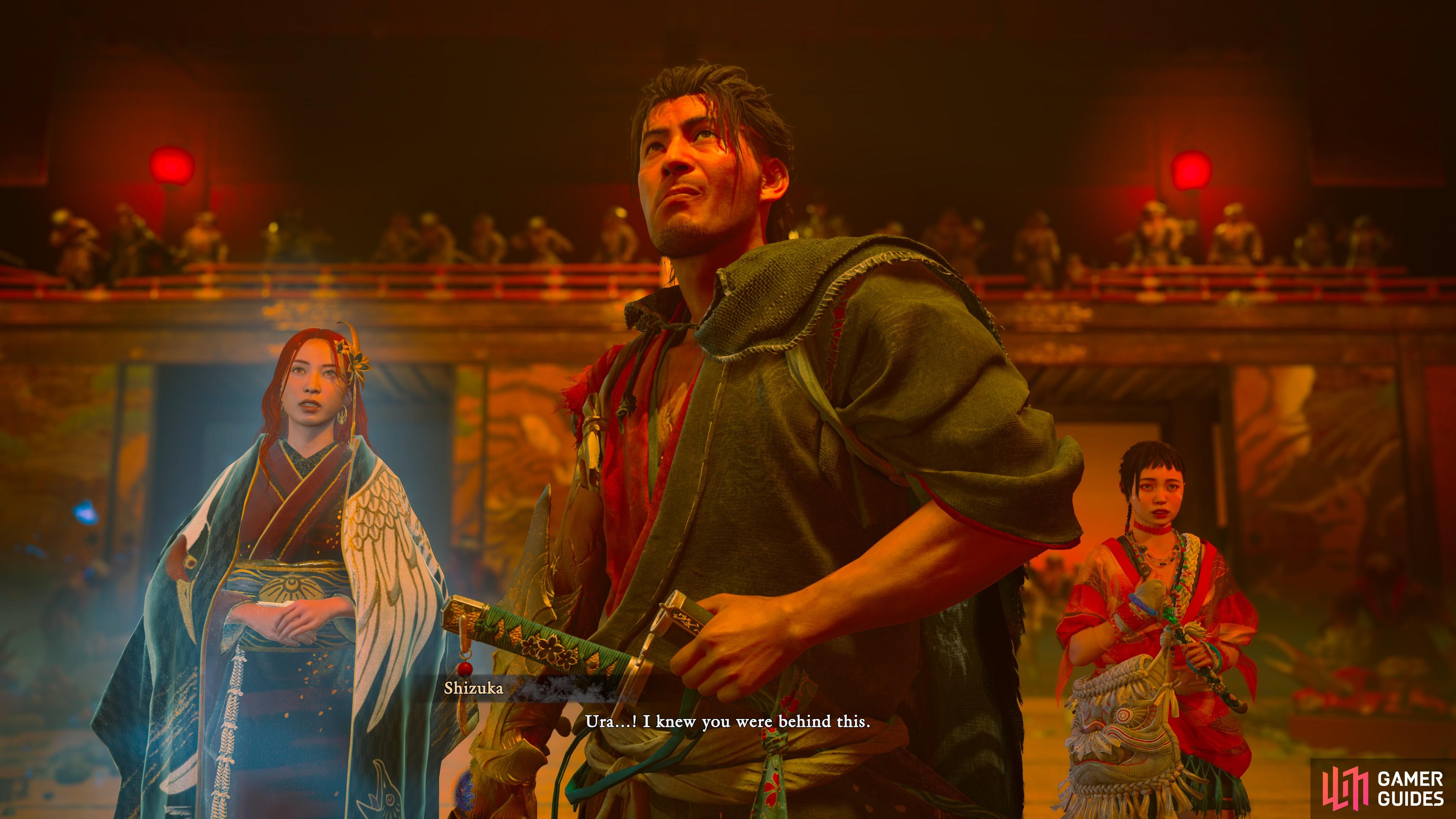
Onimusha tells a simple but effective story.

Interactions with the supporting cast are a joy.
Shivering with antici–
Onimusha: Way of the Sword feels like it’s constantly building. Layering ideas, systems, character moments, and more into something bigger and bolder with each passing minute of play. It’s a risky way to construct a video game, because if at the end of 20 or 30 hours you don’t feel like the payoff has been worth it, then it will inevitably leave you disappointed.
Thankfully, the game does pay dividends, from the smallest scale to the largest movements. Successfully reading an enemy’s strike, parrying it, and striking with one of your own is always a gratifying barrage of metal clanking off of metal, enemies getting struck through, and particle effects flying across your screen. The promise of becoming the greatest sword in all of Kyoto is upheld by a protagonist and cast that can make that journey feel epic. Onimusha: Way of the Sword not only builds to something greater but reestablishes the series in grand fashion.
Way of the Wow
Rewarding and deep gameplay, finely tuned progression, great characters, and industry-leading animation come together to form a once-in-a-generation action experience. As a result, Onimusha: Way of the Sword is a lean, mean, eminently playable experience more than worthy of your time.
Gameplay:
Sound:
Graphics:
Story:
Value Rating:

No Comments