| Icon | Title | Category | Subcategory |
|---|
Karakorum Ruins
| Icon | Title | Details |
|---|---|---|
|
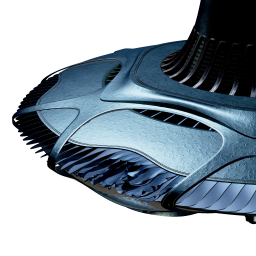
Power Plant Turbine |
Protein-marker scan complete. Analyzing tensors. Critical component of the Axum power plant codenamed “Karakorum” by pioneers. Before its sudden destruction, this turbine captured hot water flow to turn the generator. —Original turbine replaced by more advanced alloy upgrade approximately 300 years ago; coincides with switch to methane-burning power Assessment: find source of necessary material for repairs with habitat builder tool, then connect turbine to hot water source and restart power plant |
|
Heat Pipe |
This pipe once channeled hot water from the titan rockbore below into the turbine above, spinning it to generate electricity. Deposites of corrosive fission products (or “crud”) in the pipe indicate that the water flowing through it was once expelled from an active nuclear fission reactor. The water in the rockbore below is now significantly less radioactive, suggesting that the fission source—whatever it might be—has died. The pipe has not been used for at least two centuries. Assessment: treat bloom growth, then extend pipe to return power plant to operation. |

|
Upper Control Room |
All major power plant systems are connected to this main control room. Once repaired, the plant can be restarted here. The controls must be configured correctly or the plant will abort startup. Spectral analysis detects alien language outside the human visual range. Recommend adaptation to improve your visual range before attempting to startup. |

|
Metal Farming |
Electrowinning, or ‘metal farming’, is the extraction of dissolved metal ions from seawater. Electric current transmitted through a wire or pillar attracts positively charged metal ions, which form a solid plate on the wire. Due to the high metallicity of Proteus, the seas contain near limitless quantities of dissolved metal. The Axum apparently developed electrowinning to gather metals long ago, well before fire or high-temperature smelting. They may have been inspired by bacterial fibers which attract metal ions as insulation and armor. If the Axum possess an electrical sense (like many ocean organisms) they would be able to detect electrical current running through these fibers, which would lead them to the development of wires and basic generators. Operating instructions: |

|
Rosetta Stone |
The “ —Approximately 250 years old The known text on the monolith is written in Architect Linear, first translated by Architect devices discovered on 4546b. Architect Linear is remarkable for its extremely clear, unambiguous grammar and lack of context: it behaves like a programming language designed to compile on a wide range of hardware. Since first contact on 4546b, all Alterra intelligences have been programmed to translate Architect Linear for their users. It is unlikely that Architect Linear can be spoken aloud. The unknown text is written in a glyph system provisionally designated Axum Radial A. This system is logographic: each glyph represents an entire word or concept. Discovering additional glyphs will help translate more complex Axum texts. Conclusion: the Axum left this monolith as a message to Architect visitors. Be alert for signs of Architect activity, including robotic constructs and samples of kharaa bacterium. |

|
Climate Lab |
The upper observatory tower has been extensively modified. —Original structure reinforced with corrosion-resistant high-temperature alloys These changes probably occurred more than a thousand years after the observatory’s original construction. Assessment: the observatory was repurposed as an anchor for a long-term monitoring station. The builders expected the station to be abandoned, so left it completely automated. Recommend entry and data retrieval. |

|
Power Plant |
This enormous electrical power plant is a hybrid methane/hydroelectric design. Analysis suggests it has been refitted and redesigned several times. —Originally a hydroelectric turbine, powered by hot water from the titan rockbore below Assessment: the plant can be returned to operation if key components are replaced and the heat pipe is reconnected to the titan rockbore below. |

|
Orrery |
This model of an alien solar system contains two stars, seven planets, and three moons. —Two binary stars orbiting in physical contact. Proposed names: “Eido” and “Thea”. Observations at the sea surface suggest they are class M0V red dwarfs, smaller, colder, and longer-lived than Earth’s sun. Nearby stars are also indicated by lights around the orrery, including a pulsar. Pulsars can be used as lighthouses to fix a star’s position in the galaxy. Consult the Noetic Advisor for further analysis. Assessment: this orrery is probably a historical site. It was built by Axum with an advanced but pre-modern understanding of astronomy. Until a colony observatory can be constructed, it represents the best available information about the Eido-Thea system and the worlds near Proteus. |

|
Observatory |
This tower was likely built as an observatory (best fit theory) or an above-water forge (low probability alternative). The upper tower has been extensively rebuilt.
Evidence suggests this tower was built to raise telescopes above water for weather and sky observation. Structures in the interior may have been involved in mapping and modeling the local solar system. Assesment: locate and repair original power supply to open the observatory. Pioneer-built generators are incompatibile with the alien electrical grid. |


