
A mesmerizing Metroidvania that holds considerable rewards for the most dedicated explorers


Pros
- Beautiful and unique art style
- Wonderfully atmospheric soundtrack
- Slow burn narrative really pays off
- Rewarding, curiosity-driven exploration
Cons
- Unrefined core combat and platforming
- Inconsistent controls can cause frustration
- Difficulty spikes may lose some players
The gradual unfurling of a Metroidvania map is one of gaming’s quieter, more dependable pleasures. It’s also one we’ve seen a lot of in recent years. In the same way that Super Metroid and Castlevania: Symphony of the Night once inspired a generation of game designers, influential modern classics like Ori and the Blind Forest and Hollow Knight have opened the floodgates for new wave of genre hopefuls. And it’s from this frequently plundered wellspring that MIO: Memories in Orbit has emerged, like so many others, seeking a place in an increasingly crowded market.
In some ways, this new title from Parisian studio Douze Dixièmes is one of familiar pleasures. One of learning a place by feel rather than by instruction. Of delving down, poking up, nudging left and right, and feeling out the edges of a map until something gives. Where new abilities peel back another layer of an onion-like environment on the path to eventual mastery. But MIO is not content to simply emulate the joys of gaming’s recent past. It has grander ambitions.
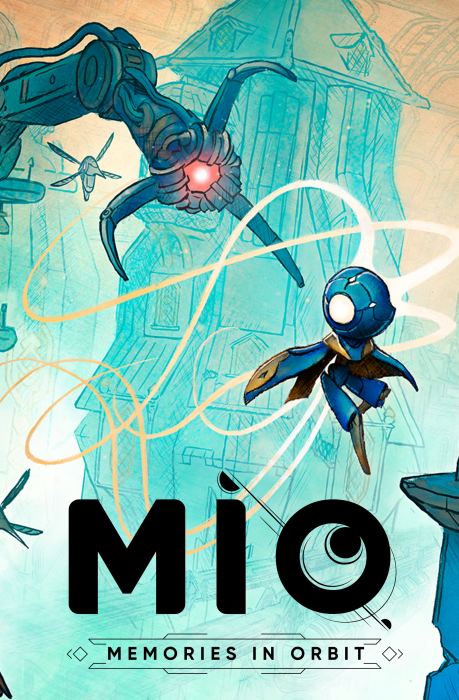
The studio cites a range of cross-media influences informing its striking art style. 3D models, line art, and some creative texture and shader work create the impression of a hand-drawn comic in motion, sketched before your eyes (with visible pencil strokes). The action plays out on a 2D plane, but the 3D perspective allows the artists to dazzle with a sci-fi vista stretching into the distance, or sell you on the fantasy of its pocket-sized protagonist with a tremendous sense of scale. A multi-textured soundtrack completes the aesthetic, comprising lo-fi synths and breathy, choral chanting, and is a highlight throughout.

MIO’s aesthetic inspirations reach beyond the world of video games. It is impossibly beautiful at times.
Digital Archaeology
After an evocative opening sequence, our protagonist is “born”. A disembodied consciousness in a mysterious digital ether, piped into a tiny mechanical body sprouting glowing tendrils from a spherical, pearl-like head. MIO awakens in a world gone wrong. The Vessel, a vast spacecraft drifting aimlessly through the cosmos in a state of abandonment and disrepair, is on the brink of total shutdown. There are no humans aboard, only a swarm of machines built to maintain the vast technological ark. Some have succumbed to corruption and will attack on sight, forming the game’s roster of enemies; others have ceased to function altogether, lifelessly littering the hallways.
The major events have already happened, with traces left behind for the player to uncover. MIO is tasked with seeking out the ship’s malfunctioning AI caretakers to untangle the mystery. What is the Vessel? What led to its decline? And what, if anything, can be done about it? The game is more interested in offering questions than answers, and firm details are deliberately hard to find and difficult to interpret. You are required to play digital archaeologist, scavenging for clues, interpreting cryptic messages, and slowly piecing together the narrative puzzle. It does eventually cohere. There’s a gripping tale to uncover, with interesting twists on classic sci-fi tropes and a surprisingly warm humanistic core.
A memorable optional sequence involving a particularly obtuse navigational puzzle, followed by a nightmarish platforming gauntlet, will separate players who are satisfied with a firm but fair ten to fifteen-hour experience, and those for whom MIO will become a temporary obsession…
An Evolving Challenge
In play, you’ll quickly settle into a familiar rhythm of non-linear exploration and ability-gated backtracking. The early-game can be challenging in spots, but there are ways to mitigate it. Currency is lost on death, but can be “crystallised” to avoid permanent loss. Platforming and combat can be lethal, but customizable mods - a fusion of Hollow Knight’s Charms and NieR Automata’s Chips - offer ways to even the odds. Unlockable movement abilities (a grapple, a glide, etc) quickly consume a limited energy resource, but there are simple ways to recharge it. Abilities are uniformly useful, and often more powerful and flexible than you might expect.
The way you interact with the environment and navigate its spaces evolves as the move set expands, and the complexity of the level design grows along with it. A potent mid-game movement ability cleverly recontextualizes the environments you’ve come to know so well, offering an unexpected level of navigational freedom, teasing out ever more creativity from the designers to test your newfound power. Optional areas escalate the challenge and ask you to master every ability, as well as MIO’s pleasing sense of physical momentum (which makes movement fun in and of itself).
The evolving relationship between the player and The Vessel as a play space is perhaps what comes to define MIO, which hides significant complexity and savage difficulty behind the game’s gentler opening hours. A memorable optional sequence involving a particularly obtuse navigational puzzle, followed by a nightmarish platforming gauntlet, will separate players who are satisfied with a firm but fair ten to fifteen-hour experience, and those for whom MIO will become a temporary obsession, capable of swallowing many times that. There’s no Castlevania-style upside-down castle here, not quite, but some galaxy-brain puzzle and level design lead to genuine moments of wonder and discovery.

Regular enemies won’t trouble seasoned vets. Bosses offer a fiercer challenge

but late-game platforming will humble even the most skilled players.
The Price of Ambition
MIO rewards your curiosity, and as the curtains are pulled back, it’s hard not to be impressed. It becomes a more interesting game the longer you play, and at times, the ambition on display can be intoxicating. It can also be its undoing. The Vessel’s greatest secrets and most satisfying payoffs are well worth the effort to seek out but will be kept, I suspect, beyond the patience threshold of some players, with all the scale and scope occasionally undermined by unrefined core mechanics.
Combat is not a strength. Rank-and-file enemies aren’t very visually distinct and there’s little in the way of creative encounter design. Bosses are more varied and provide a sterner challenge, but rarely offer anything that hasn’t been done better (and often) elsewhere. There are highlights, but MIO’s core move set never fully satisfies. Inconsistent response to directional inputs (play this one with a D-pad) and spotty hit detection can cause frustration as the difficulty escalates. Enemy attack tells look almost identical to your own impact effect, making a vital parry-like dodge difficult to perform. There’s an absent layer of polish that’s keenly felt when the going gets tough.
Inconsistencies surface in platforming, too. There’s a slight sluggishness to the controls and a sponginess in the way MIO interacts with enemies and the environment that prevents it from feeling electric in the hands in the same way as the genre greats. There are some brutally challenging sequences here, and it’s in these climactic moments where the game really tests you that it sometimes lets you down. That I was desperate to keep going is a testament to the pull of MIO’s mysteries and the allure of the carrot forever dangling in front of your nose.

Out of reach items are the least of MIO’s mysteries, and its endgame hides secrets upon secrets.
Nothing Ventured…
A Metroidvania that falls just shy of greatness might be a tough sell with the saturation of high-quality alternatives flooding the market. But to really sell MIO would be to spoil its best moments. It may not nail all the fundamentals, but MIO accomplishes something rarer and equally valuable. It surprises. And that is the power of a project like this. A work content to eschew conventional design wisdom and take risks in pursuit of a vision, and one that hasn’t been focus-tested into triple-A oblivion. Enter expecting rough edges, and you’ll find an experience built not only with passion, but also with real artistic and design intent. MIO will infuriate some players, but for the most dedicated, offers an experience that will live long in the memory.
A Space Odyssey
Well-worn genre tropes give way to surprising hidden depths. A complex, flawed, gorgeous, and remarkably generous game that will surprise and delight even as it frustrates.
Gameplay:
Sound:
Graphics:
Story:
Value Rating:

No Comments