
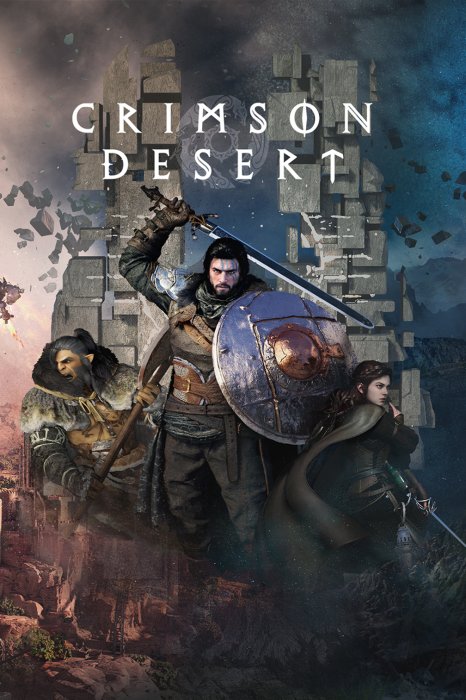
Crimson Desert is a chore-some slog, trapped under the weight of its own ambition and scale


Pros
- A truly huge and often beautiful world…
Cons
- …That world is rather boring, and exploring it is rarely rewarding.
- Combat deeply unbalanced and unresponsive.
- The story lies somewhere between nonsense and non-existent.
- Basic movement and platforming feel bad.
- The game has no identity of its own.
Disclaimer: The majority of this review was written before the most-recent patches, and we felt the need to stay true to the reviewer’s experience during their 100+ hours spent in Pywel.
In its attempt to include a bit of everything from the last 15 years of game design, Crimson Desert ends up doing almost nothing well, and a lot of things quite badly. From a vapid open world that only feigns interactivity to constant, unengaging busy work. And from a story full of dated mission design and dreadfully dull characters, to a combat system totally at odds with the game’s own balancing, Crimson Desert’s successes are fleeting, with virtually no new ideas or worthwhile rewards. At the time of review, its peerless grind was almost fascinating; however, post-release patches aimed at smoothing out the experience have generally sanded down the one distinct characteristic the game once had.
It tries to paper over its myriad of subpar activities with a grand scale, cutting-edge graphics, and a mammoth runtime, but the result is a painfully slow, generic slog caught between genres with no soul of its own. It is digital celery, a gaming experience that burns more calories than the nourishment it provides, an endless list of chores with no reward but more labor, silhouettes of enrichment. Ironically, it’s in its failure to deliver on the promise of an epic, living, breathing open world that Crimson Desert creates an experience that captures the worst aspects of the drudgery and dreariness of modern life with a game that feels more like a chore-some second job than a grand adventure.

Crimson Desert features a massive world that you can explore.
The Story Bone is Connected to…
There is a word that is impossible to escape when playing Crimson Desert: Why? Why should I care about these characters? Why should I want to engage with all these systems? Why can I not fast-travel if I am moving? Why does Kliff always know where to go and what to do until he suddenly doesn’t?
The game gets off to somewhat of a baffling start. After he and his fellow Greymanes are ambushed, Kliff — the world’s most boring man — dies only to be revived by mysterious forces. From here, a local man leads him to the main village of Hernand. With no real direction as to why, the game prompts you to talk to a beggar (one of dozens in the city). The old man thanks you for your kindness and then disappears because he’s actually a mage of some kind. From there, you enter a sewer where you find a tied-up noble lady, you untie her, and she, too, thanks you before evaporating into particle effects. With no connective tissue, the game then gives you a new objective: “Talk to the mysterious boy” on the other side of town.
Things just happen to Kliff as Crimson Desert progresses.
I have seen some people call the mission structure in Crimson Desert MMO-like; however, MMOs usually do tell you why you are going and killing five wolves or doing some other such busywork, it’s just in a text menu at a quest giver that most players don’t read. Things just happen to Kliff as Crimson Desert progresses. He finds some divine inspiration to go to a place, and when he gets there, he’s usually just in time to save the day or help someone out. He then gets an objective to kill someone who is undeniably evil, and every now and again, he encounters a mysterious, magical stranger who tells him how good and pure he is, even if you have been looting every peasant’s home on your merry adventure.

The story is often a chore to play through.

With scenarios that seem random or undertaken without question from Kliff.
The story of Crimson Desert is basically fantasy Mad Libs, with generic factions whose politics and motivations seem to stop and end at “they are at war with each other”, and multiple races (including orcs, goblins, cat people, and magic forest children) with no real discernible cultures.
This is not helped by the fact that the characters you are surrounded by for 100 hours are hardly sketches of archetypes. You have Clive—I mean Kliff as the gruff and grizzled stoic hero, and your allies include: the drunk with a receding hairline, the lady with the bow, the dumb big guy, and half a dozen white guys with beards and nothing to say. You’d think the two other player characters might bring something to the table; however, despite Oongka being the only Orc member of the Greymanes, and Damiane, apparently being an uneasy ally, these two characters are virtually mute for large segments of the game, and never have any unique perspective to bring to any of the many “group planning an assault on a castle” scenes. There is virtually no friction in camp, bar a handful of humorous interjections by the alcoholic Yann, calling someone a nonsensical curse.
You do have to play as both Oongka and Damiane in two midgame quests, but up until that point, there is virtually no reason to engage with either. In fact, you are disincentivized because Oongka and Damiane can’t complete any main quests bar their two individual ones, but their gear and skill trees require the same upgrade materials that Kliff does. So, you are much better off just investing all your time in Kliff’s progression, since you will much more likely need it.
Puzzling Puzzles…
This leads to maybe Crimson Desert’s most acute problem: it is fundamentally not balanced with any consistent or logical reasoning. Difficulty spikes are frequent, which is fine, but the problem is that the difficulty doesn’t come from engaging challenges; it comes from puzzles that are simply poorly designed and hard to read or bosses that will one-shot you unless you spend hours mining ores, upgrading your health, and most importantly, cooking healing items. There is not a single boss in Crimson Desert that I felt like I defeated because I figured out their patterns or thought of a good strategy; it was always because “I brought enough meat skewers with me this time.” And there is not a single puzzle I felt like I figured out using my brain, but instead by waltzing my way into the exact demands of the game.
When it comes to puzzle design, the game’s graphical fidelity is an indirect handicap. Because everything looks so realistic, background and foreground elements generally start to blur together. This isn’t like Tears of the Kingdom, where Zonai devices were obviously interactable; all the techno-magic items in the Abyss or hidden caves are carved from the same stone surrounding them, so you will probably find yourself bumming around puzzles for ages trying to figure out just what the game even wants you to interact with.
Shortcutting or sequence-breaking puzzles in clever ways usually doesn’t work with environmental interactions…
What’s more, while Crimson Desert certainly portrays itself as a big, open game, where you can do what you like and approach things how you want, that is far from the truth. It is painfully rigid. Shortcutting or sequence-breaking puzzles in clever ways usually doesn’t work with environmental interactions, only operating logically when the game deems it the correct solution. You’re not going to solve any of these puzzles your way. In one case, I was told to summit a great spire piercing the sky. Always liking a challenge, I decided that instead of climbing the inside of the spire and solving the required puzzles, I would scale the outside of the structure, using stamina items to keep me going. After a few attempts, I got to the top. The game crashed.

Puzzles often fail to give you any clear indication on what you should do and how.
… and Boss Bother
The underlying issue with combat is that Kliff, Oongka, and Damiane’s movesets are built for a very different type of combat than the gameplay principles that the bosses were designed around. Kliff’s hack-and-slash movement (especially early on) is extremely mashy. Fighting footsoldiers could be done on autopilot with autocombos that make most of your heavily animated moves flow together. However, the bosses in Crimson Desert feel like they were designed by a totally different development team. Bosses that can chain attacks and easily stunlock you feel like they are ripped out of a Soulslike game, and moving Kliff is simply not responsive enough to make these fights feel coherent. It is as if a player character in Dynasty Warriors was pitted against Malenia, Blade of Miquella. It feels terrible.
A handful of bosses attempt to have gameplay gimmicks and don’t take damage by traditional means. However, these too are frustrating because, despite its hundreds of text-based tutorials, the game is really poor at telegraphing how you are meant to deal with these enemies. Some unique bosses simply need you to use your basic force palm ability several times to stun them; however, others require you to have unlocked optional skills on the skill tree to do any sort of reasonable damage to them. There is a special kind of pain reserved for when you have been banging your head against a boss for ten runs only to find out that the only way to hurt them is if you re-specced your skill tree.
Balancing Act
Crimson Desert seems aware of how unavoidable damage is because the very first upgrade you “Learn” is an instant dodge roll recovery after you get hit. This move feels like a tacit acknowledgement that blocking and parrying is a fool’s errand and you’d be better off taking the hit, rolling away, and drinking a bowl of clear soup.
Most of the twelve chapters in the game follow a familiar pattern: Do some menial busywork for a few quests, get to a boss, get your ass handed to you, reload a checkpoint, walk around every village buying food for cooking, run a circuit of the mining ores you’ve discovered, cook as much braised meat as you can fit in your pockets, maybe upgrade your sword if you can, try to fight the boss again. If you die again, it’s probably not your skill at fault; you just need to hunt more wildlife for meat, because the village shops that sell food only restock once every few days have passed. It is a mind-numbing loop, not helped by the fact that bosses’ long intro and phase-change cutscenes cannot be skipped, only sped up to play like an old-timey vaudeville comedy act.

Bosses will employ gimmicks without any guidance on what it may be.

While some will one-shot you regardless of how well you are prepared.
Chapter 11 is especially brutal to get through, thanks to two mid-chapter bosses that will one-hit kill you dozens of times, no matter what armor you have equipped (mainly because most armor in the game has similar starting stats). Once you finally do stun these tanks, you are required to climb them with the game’s extremely finicky platforming controls to stab their weak point (you cannot deal damage to the weak point with your bow and arrows, of course), and if you’re not fast enough getting to the top, they will send out a shockwave and kill you instantly. This can be mitigated with the game’s self-revive items, but the existence of those items also feels like an admission that Pearl Abyss couldn’t find a good balance between challenge and unfairness in bosses. Right after this, the final boss of the chapter can’t be damaged with melee hits, so if you haven’t acquired a skill that lets you reflect projectiles, and are out of the item that lets your respec your character (like I was), then you will simply have to buy 200+ arrows and spam those while spinning in a circle for 10 minutes.
Platform Peril
It is also worth noting that Kliff is just a generally unresponsive character to move through the world. The focus on animation priority makes sense for a Soulslike game, but Crimson Desert often introduces platforming challenges that require a precision that the standard movement cannot provide. To deal with this problem, Pearl Abyss added a platforming-specific movement system when you hold down the left shoulder button. Kliff’s movement slows to crawl, and you aim at nearby platforms you want him to jump to, without overrunning because of the game’s strong momentum.
It is also worth noting that Kliff is just a generally unresponsive character to move through the world.
It’s a bizarre throwback to PS1 platformers, like Tomb Raider, created before devs fully figured out direct control in a 3D space. It would be frustrating under normal circumstances, but it’s made worse by the fact that most of the platforming challenges take place in the Abyss, 1000s of meters in the sky. If you miss a jump, then, more likely than not, you will have to fall all the way back down to Pywell and fast travel back up, or reload a save point, which doesn’t actually save your exact location in the Abyss, but always spawns you at the starting area of each challenge.
Downshift
Another recurring theme in Crimson Desert is that everything in this game takes forever. Slow-paced games are no rarity, and I actually find quite a bit of value in things like the melancholic meandering of Red Dead Redemption 2 or the isolated wandering of Death Stranding. However, Crimson Desert’s slowness doesn’t feel purposeful; it feels like padding.
Be it the minute-long loading screen of Kliff walking through some Assassin’s Creed Animus-looking visual effects every time you boot the game up or load a save, the laborious mining and woodcutting animations, or the noticeable half-second beat… that every NPC takes between every line of… dialogue, Crimson Desert takes every opportunity to slow things down to a crawl. I have seen some players insist that the game’s slower pace works really well for the experience if you treat it more like an open-world survival game á la Valheim.

Kliff generally moves slowly, and thus, platforming can be a real chore.
I understand this argument in theory, but in practice, that is not the game that Pearl Abyss has developed, or at least marketed. Crimson Desert doesn’t sell itself as a slow medieval fantasy life sim; it portrays itself as a power fantasy, telling a bloodstained tale of epic revenge in trailers. While elaborately animated cutscene fights and the constant threats of world-ending destruction imply as much in-game. The game’s own tone seems deeply at odds with how it has been designed to be played.
Kliff can also take plenty of time off from saving the realm and start sending Greymanes on quests to upgrade the camp, rebuild liberated towns, or farm resources. This side activity is hardly tutorialized, which is odd considering how vital it is to keep the in-game economy flowing and functioning if you ever hope to roll credits. These quests take set amounts of in-game time, and Kliff can only sleep to pass this time if he is tired (i.e., hasn’t slept for a few days prior). This system isn’t bad in a vacuum — upgrading your little camp is somewhat satisfying — however, there will come a point when you are just letting your PC/console run, waiting for four guys to come back with some cabbages you can roast so you can finally go fight a boss again, and that feels a bit tonally odd.
The Dragon Debacle
I wouldn’t mind these limitations and design choices if Pearl Abyss were consistent with them or even seemed to stand by the design ethos of the game it has built, but neither is true. Towards the end of the game, you unlock the ability to ride a dragon, which sounds awesome, but it is a bit less thrilling in practice.
This is because the dragon can only stay spawned for about fifteen real-world minutes or until it dies. After that, you then need to wait for an entire in-game day, or one real-world hour, before you can summon it again. You’d think that sleeping would help mitigate this; however, unlike your troops on assignment, your dragon cooldown does not continue to charge as you sleep. Whether you like it or not, you are waiting an entire hour before you summon your dragon again.
…when I respawned I found out I would have to wait until an hour passed to summon the dragon again to take on the main quest.
In my case, I unlocked the dragon during the story, at which point I was told to assault a flying keep. I obviously wanted to play around with my new ride, so I flew off in the opposite direction, messed around for a while, got off it to clear out a bandit camp (the dragon can’t get too close to cities or villages), died, and when I respawned I found out I would have to wait until an hour passed to summon the dragon again to take on the main quest.
At least that is how the game currently functions. During the review period, Pearl Abyss updated the game several times to mitigate pain points that were coming up frequently in the reviewers’ Discord, and since release has hurried out several patches addressing the high damage of several early game bosses pretty much as the community reaches them in real time.
Infuriating Inventories
The most notable changes so far come in the form of a patchwork fix of the game’s frustrating inventory system. When I first started reviewing the game, Kliff started with just 50 inventory slots and nowhere to store his gear. Infuriatingly, quest-dependent items, which often cannot be sold after they have outlived their usefulness, take up a slot. Pre-launch, Kliff’s inventory was painstakingly increased only by completing various sidequests; however, shortly before launch, his starting inventory was increased to 100 slots, and certain stores started selling inventory upgrades, too. After launch, Pearl Abyss even changed a chest in the camp, which had been a place for loot you didn’t pick up from stronger enemies to teleport to, allowing it to now act as player storage.

A lot of bugs were encountered during the review period.
However, in the process of making these changes, the developer has both created new problems and totally broken the game’s economy. While the old inventory system was objectively worse, the unorganized inventory with over 200 unordered slots I finished the game with was its own kind of infuriating. Now you’ll find yourself spending upwards of a minute hunting down the ice-resistance cape you own, nestled randomly between 50 animal bones and four jars of honey, with few tools in the way of categorizing things logically. The reworking of the storage in your base feels even more like a bandaid over a whole in a hull, as it now doubles as the chest where you put “the really important stuff you don’t want to sell but don’t want in your inventory right now” and also “the place where all the junk weapons you get for killing 900 soldiers goes”, so it too becomes as mess as the game drags on.
It has to be said, having this unlimited vault space is nice. The problem is that the game’s economy was always balanced around you not being able to pick up every single knick-knack and spear off the battlefield as you went, and having to manage limited inventory space. So now, you can quickly become the richest man in all of Pywell if you just dump your extra gear in a chest before you go clearing out some camps and flip every candle and rusted helmet once you get back to town.
This all circles back to the fact that Crimson Desert seems unsure if it is a power fantasy or a life sim.
This all circles back to the fact that Crimson Desert seems unsure if it is a power fantasy or a life sim. Some parts of the game (and its original balance) would imply that Pearl Abyss wants you to slowly chip away at this world, and live and struggle in it, until you can finally, after hundreds of hours, retake the kingdom. However, as the patches come quick and fast, this philosophy is quickly evaporating, eroding the last few interesting bits of friction, leaving only chore-like busywork and inventory management, and a game that feels stranded in no man’s land when it comes to finding an identity.
Identity Indifference
The lack of coherent identity is the overarching problem that almost every issue flows back to. At some point, someone working on this game played Red Dead Redemption 2 and thought, “We should have contextual, character-specific interactive menus for talking to NPCs.” However, someone else shortly realized that they didn’t have the time or budget to create a systemic dialogue system, so now you can just say “Hi” to all these people and nothing else.
At another point, someone said, “We should have sky islands full of puzzles like Tears of the Kingdom”, forgetting that the photorealistic graphics and lack of visual indicators on interactive objects made these puzzles near unreadable. One person wanted big set-piece driven story moments that led you by the hand through epic battles and choreographed cutscenes, while another wanted the final quest to literally set a waypoint in the middle of the sky with no direction on how to get there or where to start. And someone said, “What if we put like five cat people in the game. Why? Because the Elder Scrolls has those.”
Crimson Desert is a game that feels like an amalgamation of a dozen different, better, and more refined experiences. It is a game of scale. It is maybe the most video game on the market right now. But it does nothing to make you care about things inside of this big, wide world, be it because of its lifeless story, or the fact that it’s just a slog to explore and play. It is just very hard to want to engage with the scale of Crimson Desert.

Crimson Desert seems to borrow ideas from so many different games, that it lacks its own identity.
Peek Behind the Crimson Veil
There are a handful of times during my time with Crimson Desert that almost clicked for me. Picking a direction and just riding into the distance is an alluring task, bolstered by the fact that under the right conditions, the game can be truly stunning. However, for every time I found a hidden cave to search or a sanctum that needed purifying, I also usually found a frustrating puzzle that rewarded me with yet another sword weaker than my starting blade, or a voice telling me I hadn’t encountered the right witch to start the chain of quests to cleanse this area. Crimson Desert is vast and open and freeing, right up until the moment it isn’t, the illusion shatters, and you realize you’d be better served getting back to the grind of dull sidequests and repetitive story missions.
I have spent a lot of time recently thinking about my time on this earth. The one chance I get to live and the art, people, and events that enrich that life, culminating in a hopefully long and healthy human experience that no other person has or will ever feel. And then I think about how I spent well over 100 hours playing Crimson Desert. Searching for things I got out of it, life lessons, things I discovered about game design, anything. I find precious little. I think about the other art I could have found meaning and value in with that time, and I get annoyed. I know I shouldn’t, but I do. Crimson Desert portrays its grand scale as a gift. Great value for so much stuff. But it’s not a gift, because there is no reward here, no insights gained, no joy found, just empty scale, and your time is too precious just for that.
A Mile Wide
Combat is flashy, but unresponsive. The open world is vast, but soulless. The NPCs are legion, but uninspired. The puzzles are complex, but frustrating. Systems are convoluted, but not deep. And the patches keep making the game more and more generic. The bottom line is that Crimson Desert demands at least 100 hours of your life, and it cannot justify that ask with a rewarding experience.
Gameplay:
Sound:
Graphics:
Story:
Value Rating:

Refreshing to see a reviewer that isn't worried about what everyone else is saying.
Refreshing to see a reviewer that isn't worried about what everyone else is saying.